The Parthenon Free of Scaffolding

A Monument Marked by Time and Loss
An early 19th century visitor would have found this icon of Greece and the art of architecture crumbling to ruin, its once stately columns and walls blackened by centuries of dirt, fire and smoke. Perhaps the most recent “building” activity to be noticed by that visitor would have been the recent removal of nearly all the remaining sculpture that dressed the pediments and entablature.
Restoring the View: Two Centuries of Intervention
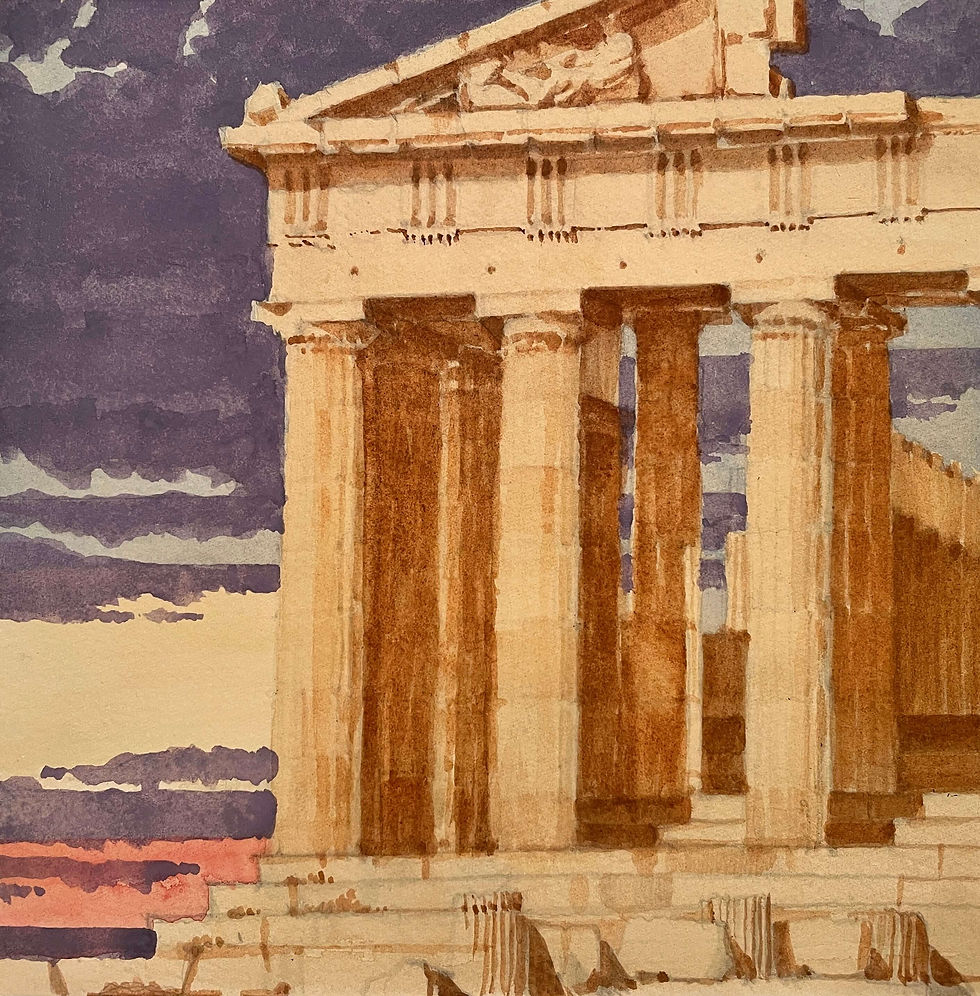
During the last two hundred years, viewing (and if you’re inclined, sketching and painting) the Parthenon and its remarkable context was negatively impacted by the presence of scaffolding erected to facilitate repairs. More recently, a crane on a track was also installed to lift, move and reinstall marble building blocks. But in September of this year, the scaffolding was removed from the western façade that first greets the visitor arriving at the summit of the Acropolis, revealing what a 19th century observer would have seen.

A Breathtaking Moment of Revelation
The view is more breathtaking than ever.
And cause for reflection: Why is this building, even in its highly deteriorated condition, venerated the world over?
Architectural Refinement Without Equal
Entire books have been written describing the peerless quality of the Parthenon’s architecture and art. The building’s proportions, the resolution of its outside corners, and the subtle sophistication in the curvature of the columns and base are among the greatest refinements of ancient Greek architects. The sculptures also represent the finest achievements of artists of their time, landing them in local and foreign museums. Though ownership of the sculptures is still contested today, one consolation of their dispersal is that they have been and remain protected.

The Acropolis: Context and Approach
This temple stands above all others of its time also in part because of its location within the greater context of the hilltop site and other structures that make up the Acropolis. The approach to the Parthenon is made by ascending a grand stair coursing through other secondary structures. Among ancient monuments, the anticipation this stairway brings might only be rivaled by the approach to Machu Pichu or the Treasury at Petra.

An Ancient Monument in a Vibrant Modern City
Furthermore, unlike those two monuments and most all other significant Greek temple sites, the Parthenon is surrounded by a vital modern city, giving it greater presence in the lives of the Greek people who have understandably made it a symbolic icon of their nation. Like the Parthenon, the Greeks and the democratic social system their ancestors inspired have survived centuries of natural and manmade disasters. The Parthenon represents the very soul of Greece.

A Monument That Stirs Emotion
Loss and Destruction
Most importantly, the Parthenon stirs a broad range of emotions. First, a sense of loss. Under Ottoman control during a 17th century war, the building was used for storing munitions. A Venetian cannon shell scored a direct hit to the magazine, sending many walls, columns and sculptures tumbling to the ground. Tragically, despite also suffering the ravages of time and nature, the greatest damage to the temple was inflicted by man himself.
Survival and Hope
But then, a sense of hope. The ongoing effort to maintain the ruins is inspiring. We all revere survivors, and this one has been through as much as any other monument one can name. Its original use and meaning are still being researched and debated, while in the centuries since its construction, it has been both a Christian church and an Islamic mosque and survived the alterations that these more recent occupants have installed. It has also endured fire, war, an earthquake, acid rain and misguided restoration techniques.

The Parthenon represents the best that mankind can build as well as our resilience in the face of great adversity.
About the Art
Comments